Anyone can call themselves a sports facility expert, but are you paying for the right...
Read More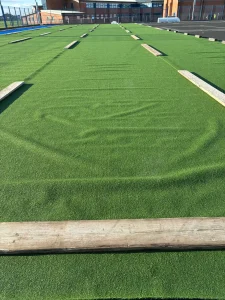
Fun quiz time, the photographs above show examples of issues where the contractors were unable to identify a suitable solution, requiring me to step in and provide technical guidance.
Left photograph – manufacturing-induced creasing
This was a particularly challenging example of creasing introduced during the manufacturing process. The problem was compounded by the fact that the crease had nowhere to ‘kick out’ to, being effectively trapped by the sides of the roll.
My recommendation was to use a steam lance, supplied by a water bowser and mounted on a diesel-powered unit to provide the necessary mobility. This was in the far north of England in December, hardly ideal conditions, with the carpet extremely stiff and difficult to manipulate.
The science behind the solution is relatively straightforward: plastics become more malleable when heated, allowing them to be manipulated into the required position. Applying controlled heat provided the opportunity to work the crease out of the carpet, something that would have been virtually impossible under the prevailing conditions without it.
The operation was time-consuming, but ultimately successful. The pitch was straightened out and subsequently passed FIH certification.
Without this intervention, the project would almost certainly have ground to a halt, potentially resulting in a protracted dispute, lost revenue for the client and the considerable inconvenience of rearranging fixtures and associated activities.
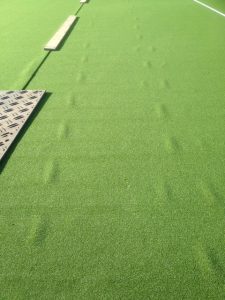
Middle photograph – contractor-induced creasing
What do these creases look like to the untrained eye? Answers on a postcard, please!
I was called in to investigate the problem under the impression that it was a manufacturing defect. However, there were some tell-tale signs that suggested otherwise. The creases were uniformly spaced but progressively closer together as you travelled down the roll. These were clues pointing towards forklift damage, with the creases representing impressions caused by improper handling.
As I walked further down the roll, I found exactly what I needed to substantiate my theory: two neat puncture holes, precisely the size and spacing of forklift tines.
Case closed? Not quite.
Having read the previous case study, you might assume this would be another relatively straightforward problem to resolve. Get some hot water on it and everything will be fine, right? Wrong!
This particular carpet was water-based, with a glass-fibre scrim incorporated into the backing. Unlike a conventional thermoplastic backing, the glass-fibre reinforcement cannot be made more pliable through the application of heat. Consequently, there was no realistic prospect of manipulating the carpet back into shape.
All affected rolls had to be replaced, which brings an entirely new set of challenges. Would the manufacturer have the same dye lot available? Would they have retained the production records, including the latex backing line temperature settings? Would the replacement carpet have precisely the same pile height? All these parameters need to match, otherwise the replacement rolls could stand out like a sore thumb.
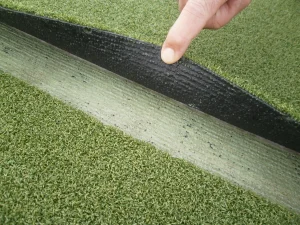
Right photograph – No seam adhesion
Again, I’m called out to a problem whereby allegedly the seams were popping on a pitch, contractor denying liability, manufacturer denying liability, glue manufacturer…you get the picture. What we can see here is there was never an effective bond between carpet and tape, or if there was it wasn’t sufficient to hold under play and maintenance activities. A sea should be walked periodically during the curing phase, the ball of your feet offers a good point load which can be fully controlled, this far surpasses the modern tendency to apply a wide roller to the joint, which cannot be relied on. Solution? Rip out all of the seams and start again, much to the dissatisfaction of the contractor who was blinded by their own pride, we’re still not on great talking terms!
Are you beginning to appreciate the scale and complexity of some of the issues encountered in synthetic turf installation? More importantly, would your consultant, or even your contractor, recognise the underlying problem, understand the material science involved and know how best to resolve it?
There is a considerable difference between knowing how to install synthetic turf and understanding the science, manufacturing processes and practicalities that sit behind it. That distinction can make a very significant difference to the outcome of a project.
What all of this demonstrates is the value of understanding the materials and construction processes themselves, rather than simply understanding how the finished facility be presented. It is precisely this combination of manufacturing knowledge, practical construction experience and technical problem-solving that I bring to consultancy work.